

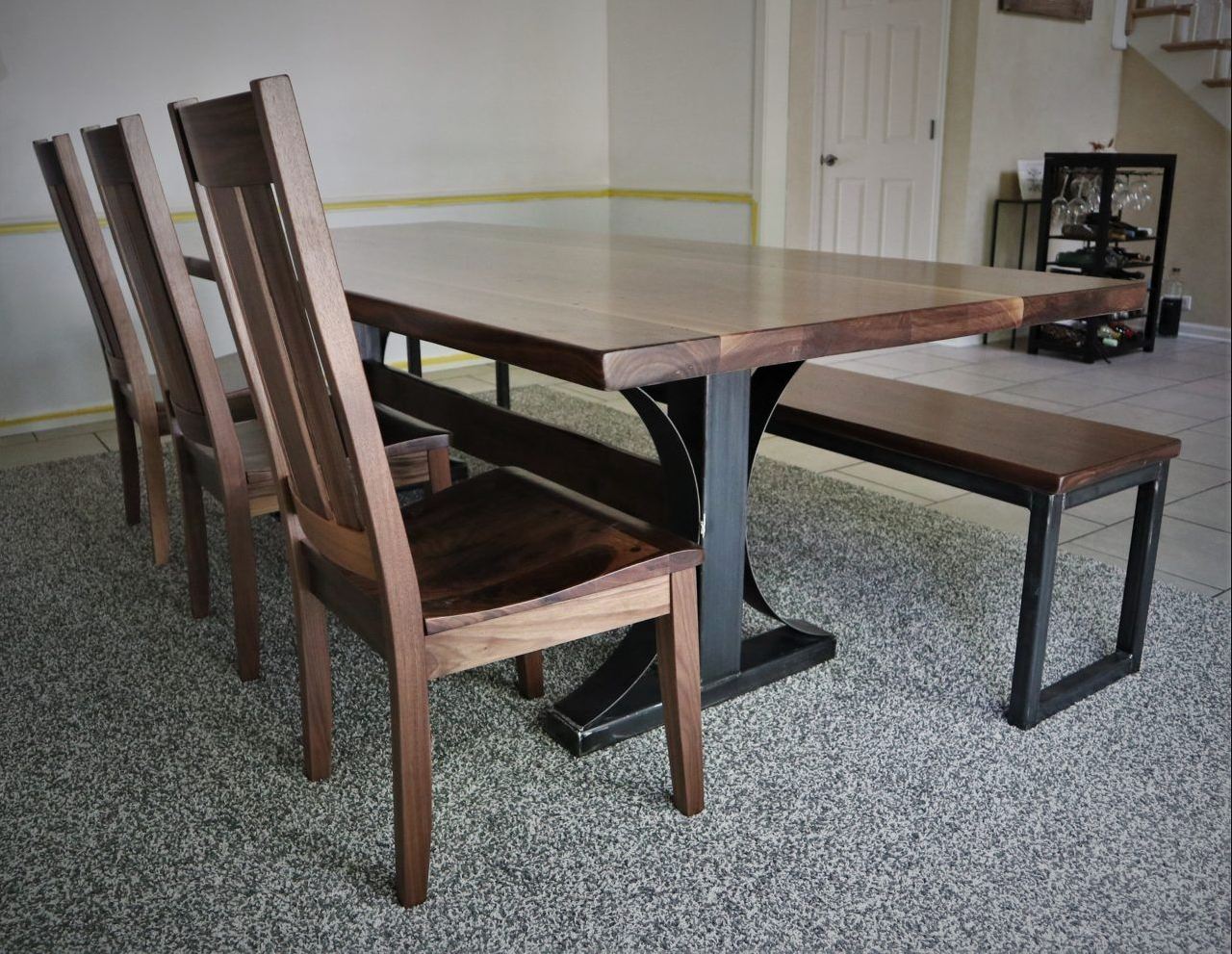
Walk into our showroom and there is one wood that stops people in their tracks almost every time. It is the dark one. The rich, chocolate-brown table that looks like it belongs in a design magazine. That is walnut.
Walnut wood has been a favorite of furniture makers for centuries, and it is easy to see why. But it is also one of the most expensive domestic hardwoods out there, so it is fair to ask: what makes walnut so special, and is it the right choice for your table? Let's break it down, from color and grain to hardness, cost, and care.
What Is Walnut Wood?
When furniture makers in the U.S. say "walnut," they almost always mean American black walnut, a hardwood that grows across the eastern and central United States, including right here in Illinois. It is the walnut we build with in our Joliet shop.
You may also see English walnut or claro walnut mentioned online. Those are different trees, generally lighter and more variable in color. If you want the full breakdown, we cover it in our article on the best wood species for a live edge table.
Walnut Wood Color: Naturally Dark, No Stain Needed
Here is the single biggest thing that sets walnut apart. Most domestic hardwoods, like ash, maple, oak, and hickory, are naturally light, with a creamy, tan, or golden tone. Walnut is the exception. Its heartwood is a naturally darker brown, ranging from a warm milk-chocolate to a deep espresso, sometimes with hints of purple or gray depending on the light.
That matters for one big reason: you get a dark wood table without stain. Plenty of tables out there are a light wood stained to look like walnut. With real walnut, the color goes all the way through the board. That is why most of our walnut pieces are left natural under a clear coat, so the wood itself does the talking.
What About the Light Streaks?
The outer part of a walnut tree, called the sapwood, is a creamy pale color. In our shop, we usually cut the sapwood out so you get a rich, uniform dark top. That said, some people love the contrast a touch of sapwood brings, especially on live edge pieces, so we can leave a minimal amount in if you ask for it. It is one of those details we talk through with you before we build.
How Walnut Changes Over Time
Most woods darken as they age. Walnut tends to do the opposite. Over the years, with exposure to light, it slowly mellows from a cool, deep brown toward a warmer, slightly lighter honey-brown tone. It is a gentle change, and most people find it makes the piece even more beautiful. Keeping the table out of strong direct sunlight helps it age evenly.
What Colors Go With Walnut Wood?
Walnut is surprisingly easy to design around. A few combinations we see work again and again:
- White and light gray walls or cabinets. The contrast makes walnut really pop.
- Black metal. A walnut top on a black metal base is a modern classic. Browse our metal base tables for ideas.
- Greens and deep blues. Sage, olive, and navy all pair beautifully with warm brown.
- Brass and warm metals. Light fixtures and hardware in brass bring out the warmth in the grain.
- Lighter woods. Walnut next to ash or maple can look intentional and layered, rather than mismatched.
Walnut Grain: Tight, With a Gentle Flow
Walnut has a tight grain with a gentle flow. Compared to oak or ash, which have a more open, pronounced grain you can feel with your fingers, walnut is smoother and more refined. The pattern moves across the board in soft, flowing lines rather than bold stripes.
That tight grain is part of why walnut takes a finish so well and feels so smooth to the touch. It is also why walnut works in so many styles: clean and modern, mid-century, or warm and traditional. And on live edge tables, walnut slabs are hard to beat, because the grain flows right out to the natural edge.
How to Identify Walnut Wood
Wondering if a piece is real walnut? A few quick clues:
- A natural medium-to-dark brown color that is consistent through the wood, not just on the surface
- Smooth, fairly tight grain with soft, flowing figure
- Possible pale sapwood streaks near the edges
- Under the finish, the end grain will look the same dark brown as the face, while a stained light wood often shows a lighter core
Is Walnut a Hardwood? How Hard Is It?
Yes, walnut is a true hardwood, and it is pretty hard. It holds up to everyday family use just fine. That said, it is not as hard as some of the oaks or hickory.
The standard way to measure this is the Janka hardness test, which measures how much force it takes to press a steel ball into the wood. The higher the number, the more it resists dents. Here is how walnut stacks up against the other species we build with:
|
Wood Species |
Natural Color |
Grain |
Janka Hardness (lbf) |
|
Walnut |
Medium to dark chocolate brown |
Tight, gentle flowing figure |
1,010 |
|
Ash |
Light cream to pale tan |
Open, bold and straight |
1,320 |
|
Rift Cut White Oak |
Light tan to golden |
Straight, linear and very consistent |
1,360 |
|
Hard Maple |
Creamy white to light gold |
Very tight and subtle |
1,450 |
|
Hickory |
Light to medium, lots of color variation |
Bold, varied |
1,820 |
So what does that mean in real life? A walnut table will handle daily meals, homework, and game nights without trouble. It may show a dent a little sooner than hickory if something heavy gets dropped on it, but a lot of people see those small marks as character. If your table is going to take a real beating every day, hickory or hard maple might be worth a look. For a side-by-side of every species, check out our wood species guide.
Why Is Walnut So Expensive?
It is the question we hear most. Walnut sits near the top of the price range for the species we build with, and it is not just because it is popular. Wood is a commodity, so prices move with the market, but right now our lineup ranks like this, from highest to lowest:
- Rift cut white oak
- Walnut
- Hard maple
- Hickory
- Ash
Rift-cut white oak edges out walnut because rift sawing yields far fewer usable boards from each log. Walnut’s price comes down to a few real factors of its own:
- Slow growth. Black walnut trees take decades to reach a size worth milling into furniture lumber.
- Lower yield. Walnut trees tend to have more sapwood and more knots or defects than some other species, so less of each log ends up as clean, dark boards.
- Narrower boards. Wide, clear walnut boards are harder to come by, and wide slabs for live edge tables are rarer still.
- Demand. Walnut has been a top choice for high-end furniture and cabinetry for a long time, so supply is always being competed for.
- No stain needed, but no shortcuts either. Because walnut is left natural, there is nowhere to hide. Board selection and matching take extra time to get a top that looks right.
Is Walnut Worth the Cost?
For a lot of our customers, yes. You are paying for a dark, rich color that goes all the way through the wood, a smooth grain that looks refined in almost any room, and a table that ages gracefully over decades. If budget is a concern, it is worth knowing that a lighter species with a dark stain can get you closer to the look for less. We are happy to show you both side by side.
Caring for Walnut Furniture
Good news: walnut does not need any special treatment. The care is the same as any of our tables, because we use the same clear coat finish on every piece we build. That finish is what protects the wood, so caring for your table really means caring for the finish.
- Dust and wipe gently. Use a soft, slightly damp cloth, then dry it right away. A little mild soap is fine for sticky messes.
- Skip harsh cleaners and oily polishes. Products with oils, waxes, or silicones can build up and damage the finish over time.
- Do not drag things across the top. Lift items with rough or gritty bottoms, like pottery, rather than sliding them.
- Keep humidity steady. Aim for 35% to 55% indoor humidity to keep the wood from moving, cracking, or warping. Read more in our article on humidity and wood furniture.
- Mind the sunlight. Strong direct sun can speed up the natural lightening of walnut and cause uneven color. Rotating decor now and then helps it age evenly.
For the full rundown, visit our Furniture Care Guide.
Walnut Wood FAQ
What color is walnut wood?
Walnut heartwood is naturally a medium to dark chocolate brown, sometimes with purple or gray undertones. Its sapwood is a pale cream color. Unlike most domestic hardwoods, which are light or golden, walnut is dark without any stain.
Is walnut a hardwood?
Yes. Walnut is a true hardwood with a Janka hardness of about 1,010. It is durable enough for everyday furniture, though softer than oak, ash, hard maple, and hickory.
Why is walnut wood so expensive?
Walnut trees grow slowly, yield fewer clean dark boards per log, and produce fewer wide boards and slabs. Steady demand for high-end furniture keeps walnut priced above species like hard maple, hickory, and ash. Among the woods we build with, only rift cut white oak currently costs more, and since wood is a commodity, that ranking can shift with the market.
Does walnut darken or lighten over time?
Walnut generally lightens slightly over time, mellowing from a deep brown to a warmer honey-brown with exposure to light. Keeping it out of strong direct sunlight helps it age evenly.
Is walnut good for a dining table?
Yes. Walnut is one of the most popular choices for dining tables because of its rich natural color, smooth grain, and good durability. It may show dents a little sooner than harder woods like hickory, but with a quality clear coat it holds up well to daily use.
How do you care for walnut furniture?
Care for walnut the same way as any finished solid wood piece: wipe with a soft, slightly damp cloth, avoid harsh chemicals and oily polishes, do not drag rough items across the top, and keep indoor humidity between 35% and 55%.
Ready for a Walnut Table of Your Own?
There is nothing quite like seeing walnut in person, and photos never fully capture how the grain moves in the light. Stop by our showroom at 18558 NW Frontage Road in Joliet, Tuesday through Saturday, 8 AM to 4:30 PM, and see our walnut pieces up close next to ash, maple, oak, and hickory. Some of them are ready to take home today in our Showroom Inventory.
Have a size or style in mind already? Give us a call at 847-401-7753 and we will talk through walnut, base options, and finishes, and build a piece sized exactly for your space. You can also browse our custom dining tables, start designing in the Digital Crafter, or request an estimate.


